

A chatbot as a tutor
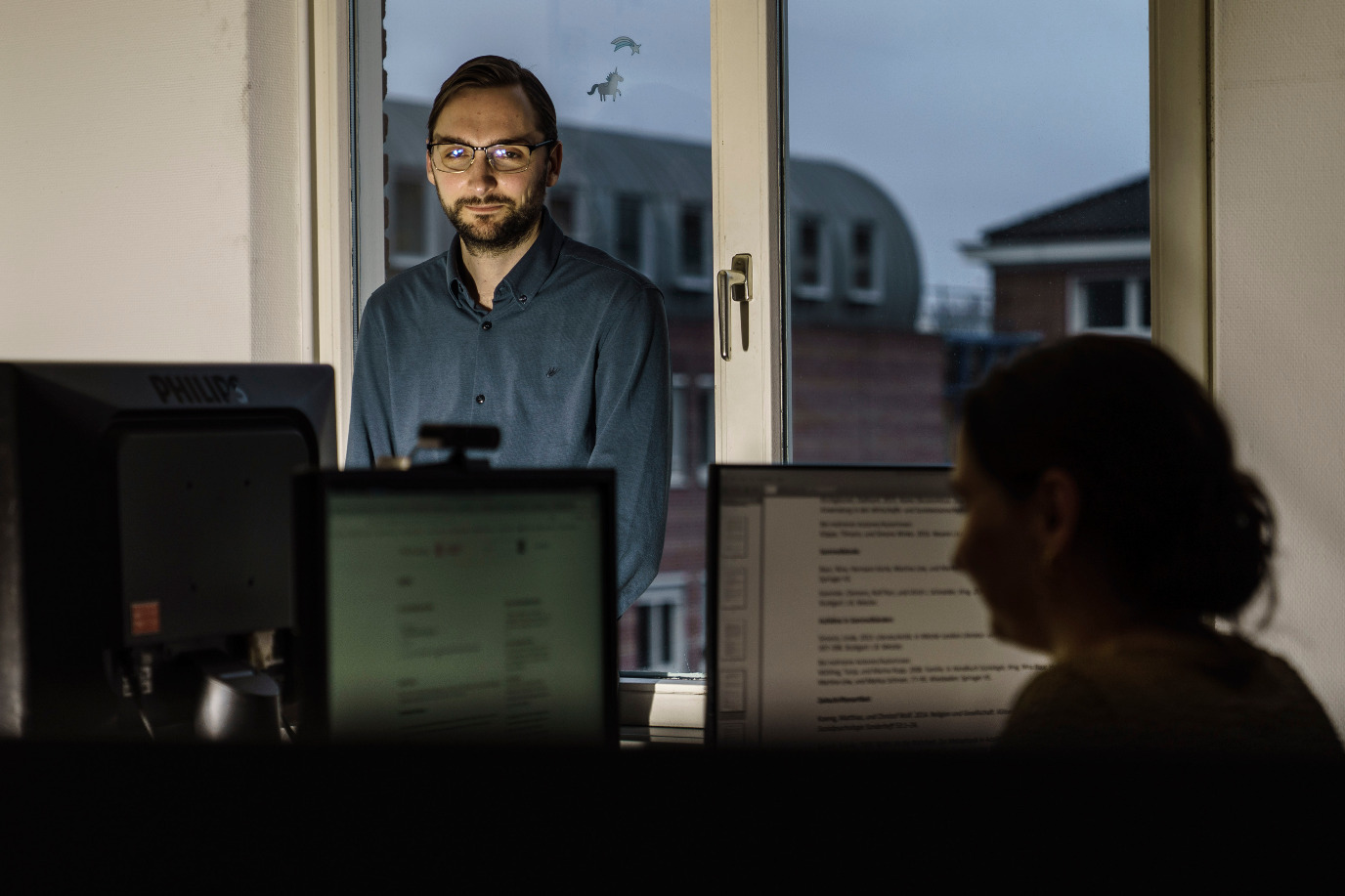
Assistant Professor computer science and Artificial Intelligence Rik van Noord, who researches artificial intelligence, helps university students and high school students use language models like ChatGPT as if they were being tutored. 'They get a kind of personal attention that they wouldn't have gotten from me.'
Text: Lieke van den Krommenacker / Photos: Reyer Boxem
Safely surfing the internet is no longer a given. Anyone who opened a newspaper in recent weeks wouldn't have had to look far for articles in which experts expressed their concerns about developments in the world of AI. Teachers fear that, while technology can promote easier and more efficient learning, AI actually erodes critical thinking skills. Moreover, not all information presented by AI is factually accurate. What is a fact, however, is that anyone can create pornography with AI, and ChatGPT easily provides suicide tips for young people who search for it. In other words, abuse is a serious and constant threat.
Regulation is difficult
'These kinds of things are, of course, very bad. And we have to be careful,' says Rik van Noord. As a lecturer in computer science and a researcher in Artificial Intelligence, he specializes in ChatGPT and other so-called Large Language Models. 'Such language models are trained to provide answers that users are happy with. And if you develop a model that can generate images very well and understands how the world works, then it can also generate a nude photo.'
Training a model to create images, but not pornography, is very difficult, Van Noord emphasizes. 'Because these models are so complex and the various skills are all interrelated, you can't simply exclude one skill.'
Van Noord recalls a scandal in Spain where students used AI to generate nude photos of female classmates in the age. 'Those girls were 12 or 13. These are very serious missteps. You can try to take measures at the government level. Like, if you create an AI model that can do this, you'll get a fine and have to take it offline. But that regulation is very difficult. And even if you train a model to refuse certain requests, there are always tricks and workarounds to circumvent such restrictions. So we have to learn to deal with it.'
The language models have been trained to provide answers that users are happy with.
Challenge ChatGPT
It's no surprise, then, that Safer Internet Day, which falls on February 10th this year, was created. This day aims to make the internet a safer place, especially for children and young people (see italic text at the end of the page). This is also what Van Noord tries to do during his guest lectures for upper-secondary school students: making them aware of the best ways to use AI and how not to use it.
He always gives the students a challenge; Van Noord challenges them to talk to ChatGPT about a topic they're knowledgeable about and to have ChatGPT make a mistake. 'This way, I let them experience that such a language model isn't always right. You can clearly see that when you can verify the information yourself.' If you can't do that, it's much harder to separate the facts from the errors, because everything ChatGPT says and shows looks very convincing.
This is how one student, a farmer's son, discovered that ChatGPT hadn't properly grasped the fertilizer regulations in agriculture. Yet another was a very good knitter and asked the model for a knitting pattern. Van Noord: "She said, 'Well, if I knit this, I really won't make any socks.'"
I challenge students to talk to ChatGPT about a topic they know a lot about and have ChatGPT make a mistake.
Smart Use
Van Noord's goal, both in his lessons for pupils and his lectures for students, is that they don't let AI do their work, but use the technology to develop themselves. And while he understands the skepticism among teachers, Van Noord is also keen to point out the enormous potential of AI.
'Imagine you're working in a primary school with classes of 25 children. Try giving them all the personal attention they deserve. A teacher can never deliver on that. Yet an AI model does have your full attention. So if you train an AI model to interact effectively with children pedagogically and didactically, it can be very beneficial.'
Research into how secondary schools and higher education institutions can use AI constructively is underway. A popular test is one in which a group of students is divided in two. One half is allowed to use AI during the course, while the other is not. AI is prohibited during the exam for all students. Van Noord: 'Interestingly enough, it turns out that under these conditions, students are very good at using AI to support their learning and enhance their skills.'

Their own thought process
Much research shows that students who use a chatbot as a kind of tutor or tutor not only have a more efficient learning experience but also achieve higher grades. For example, by first completing an assignment themselves and then asking ChatGPT how to improve it. Or by feeding the model all the exam material and having it generate ten possible exam questions. 'Or they give me the slides from my lecture and ask for more explanation on the ones they don't quite understand," says Van Noord. "That way, they get a kind of personal attention they wouldn't have received from me.'
A striking detail: those who rely too heavily on AI not only learn nothing new but also run the risk of losing some of their skills. Van Noord: 'There was an interesting study among a group of doctors in Poland, where half of the group was allowed to use technology that helps detect early-stage cancer during ultrasound scans. The other half was only allowed to use their own knowledge. Three months later, it turned out that the group of AI users had become less adept at self-assessing the ultrasound scans.'
This example underscores Van Noord's key message: the way we use AI determines its benefits. 'If you use it to outsource your own thinking, it has very negative consequences. But we mustn't forget its potential. It's up to all of us to use it effectively and responsibly.'
Safer Internet Day
This year's theme for Safer Internet Day is 'Together for a better internet'. Actions are taking place all over the world to make the internet a better place for everyone. Want to know more? Visit www.veiliginternetten.nl
Latest craze: the AI Agent
Now that the novelty of language models like ChatGPT has worn off a bit, major tech companies are busy with the next craze: AI Agents. These are AI models that have access to their own computers. 'These models can simply work for hours at a time. First, they search for information, then they write a program to analyze the data they find. They then write a nice report about it, which is then sent to you, the user.'
More news
-
14 September 2026
Dementia in migrants: does care in the native language help?
-
14 September 2026
Cesspits reveal what the Dutch ate centuries ago
-
01 September 2026
Resilient local communities essential for reconstruction