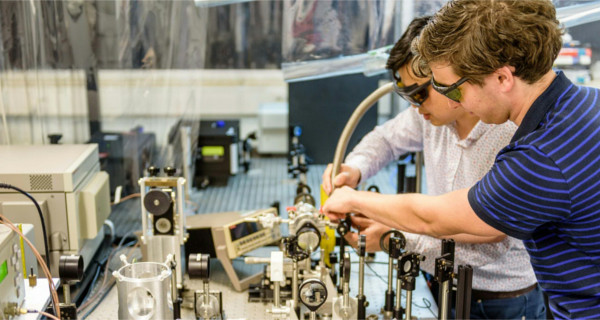
News: Top Master Programme in Nanoscience highly praised
The Keuzegids Masters 2012, a booklet aimed at prospective students and providing an appraisal of all master programmes at Dutch universities, states:
"Nanoscience is Groningen haalt een bijna perfecte score. Zowel over de inhoud als de organisatie van deze master zijn de studenten uitermate enthousiast. De experts vinden het niveau van de afgestudeerden erg hoog. [Nanoscience in Groningen obtains an almost perfect score. Students are enthousiastic both about the contents as well as the organization of this master. The experts find the level of the graduates very high.]"
"Groningen is a must for nanotechnology."
The programme receives a numerical score of 91 out of a possible 100, compared to 59 and 61 obtained by its competitors.
News: Physics at Zernike Institute judged "outstanding in every respect"
The QANU has published the evaluation of physics research at Dutch universities (2001-2009). Their report states that "The performance of the programme Advanced Materials at the Zernike Institute is outstanding in every respect."
On all four aspects that were assessed (quality, productivity, relevance, and viability) the Zernike Institute received the maximum score of 5.
News: Zernike Chair Lecture 2012 to be held by Prof. Fulvio Parmigiani
The Zernike Instutute welcomes Zernike Chair 2012 holder Prof. Fulvio Parmigiani (University of Trieste, Italy). Initially he will be here until the end of May. One of his activities in this period will be to present a course on X-ray science. In autumn Prof. Parmigiani will also present a public lecture entitled
Light and Matter.
The Zernike Chair is a temporary honorary professorship, awarded once every year by the Zernike Institute for Advanced Materials to a world-class scientist.
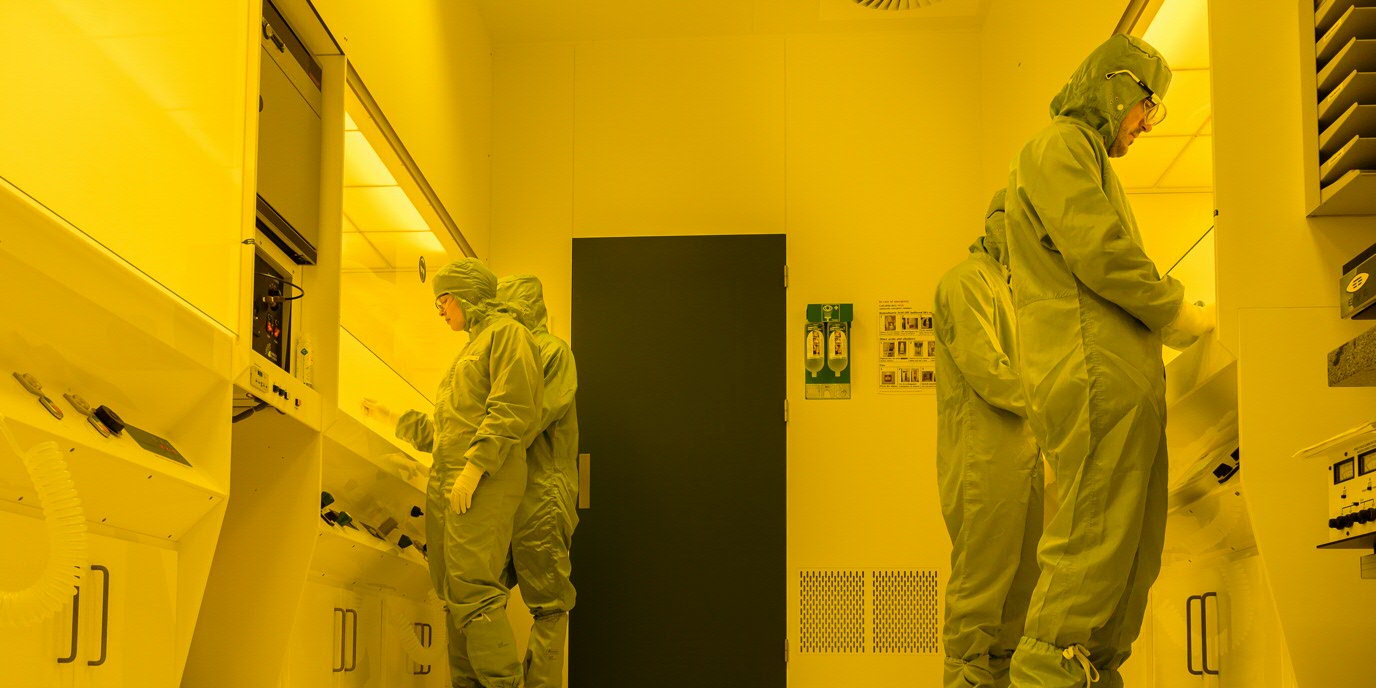
News: Efficient photovoltaic cells (1)
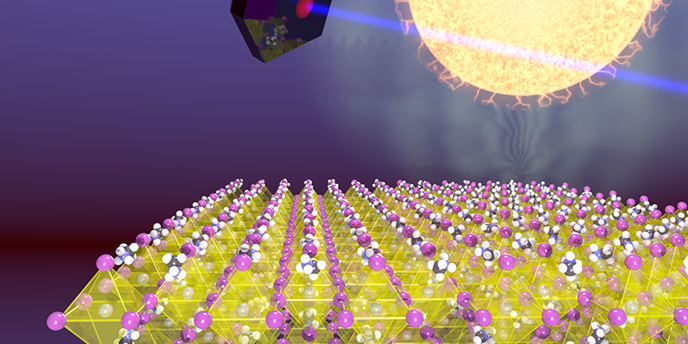
Science Express, the rapid dissemination channel of Science, features an article showing that hot-state charge delocalisation is a crucial driving force for charge generation in efficient organic photo cells. The work is performed by a collaboration of teams from the Zernike Institute (Group of Prof. Paul van Loosdrecht/Dr. Maxim Pchenitchnikov), Cambridge University (Group of Prof. Richard Friend), and Mons University (Group of Prof. David Beljonne), and partially financed by NWO and the Zernike Institute. The results provide a new framework to understand charge generation in organic systems and outline the basis for the design of improved organic photovoltaic cells. See http://www.sciencexpress.org.
News: Efficient photovoltaic cells (2)
In Advanced Energy Materials Prof. Kees Hummelen and Dr. Jan Anton Koster of the Zernike Institute and Prof. Sean Saheen (Denver University) report on a theoretical study on improving the efficiency of plastic photovoltaic cells. By using materials with a high dielectric constant, and by carefully tuning the parameters, it should be possible to increase the efficiency of plastic solar cells substantially. See http://onlinelibrary.wiley.com/doi/10.1002/aenm.201200103/abstract
News: Nanoscale cooling element
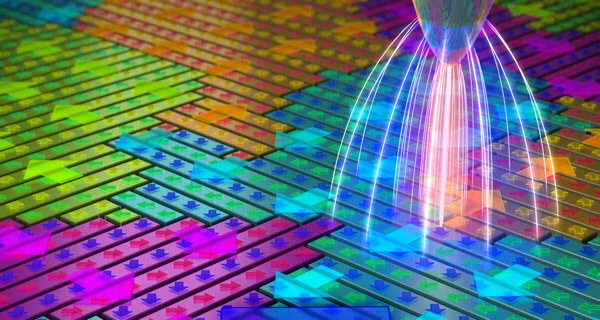
The research group of Prof. Bart van Wees has just published an article in Nature Nanotechnology, describing a nanoscale cooling element that can be controlled magnetically. The project was funded by FOM, the EU, and the Zernike Institute. See the FOM-press release for more details. The results mark the dawn of spin-caloritronics, the study of the role of the magnetic moment of electrons in heat transport.
News: New Roadmap Nanotechnology published
The research centres and industries active in nanotechnology in The Netherlands have jointly put together a new Roadmap Nanotechnology:
Nanotechnology in the topsectors [PDF]
. In January 2012, this document will be submitted to Parliament, as part of the Innovation Contract for High Tech Systems and Materials.
News: Top position of Zernike Institute confirmed
The excellent position of the Zernike Institute has recently been confirmed by Thomson Reuters' Research Analytics (publisher of the Web of Science), which ranks Groningen 4th by impact of its publications in the global Top-20, above Harvard, MIT, Stanford, Max Planck and other renowned institutes (Table 3, right-hand column in the Global Research Report of July 2011 on Materials Science and Technology [PDF]
).