

History and Location
The Institute was founded in 1904. Its primary aim at the time was to study the Vatican Archives, which had been opened by Pope Leo XIII. These archives constituted an unparalleled source of information on the cultural, political and religious history of the Netherlands in an international context. Soon, the Institute broadened its scope to other academic fields, in particular art history, ancient studies and archaeology.
After the Second World War, KNIR played an important role in strengthening the scientific and cultural ties between the Netherlands and Italy, among other things through its participation in the Unione Internazionale degli Istituti di Storia, Storia dell’Arte e Archeologia a Roma. Since the early 1990s, the Institute has focused primarily on the academic community. On the occasion of its centenary in 2004, the Netherlands Institute in Rome was granted the designation “Royal” and changed its name from NIR to KNIR.
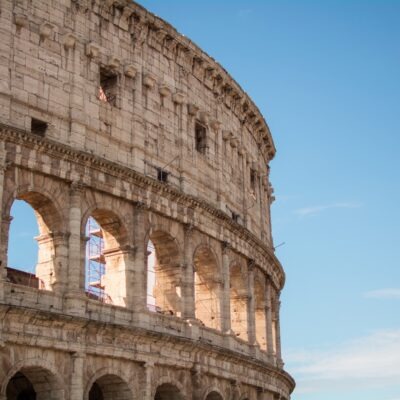
Since 1933, the Institute has been housed in its own building, designed by the Italian engineer Gino Cipriani and the Hague-based architect Jan Stuyt, with a spacious garden in the Valle Giulia — an area designated during the Fascist regime for various international institutes. The Belgian, Egyptian and Romanian Academies, the Danish, Japanese and Austrian Institutes, the British School, and two of the city’s most important museums — the Museo Nazionale Etrusco di Villa Giulia and the Galleria Nazionale d’Arte Moderna — are within walking distance of KNIR.
The history of the Institute’s first hundred years is described in detail in Hans Cools and Hans de Valk, Institutum Neerlandicum MCMIV–MMIV (Hilversum: Verloren, 2004).
The recent history of the Valle Giulia is extensively discussed in the book Rome in the World – The World in Rome, written by the Nijmegen professor Peter Rietbergen at the request of KNIR on the occasion of the celebration of 150 years of Italian unity.