Page content
Section menu
Main menu
Associative links
Page content:
English | Nederlands

Spot = star = radiation?


A Black Box full of observation techniques!

How do you research something that is infinitely huge, far out of reach, impossible to imitate in a lab, impossible to manipulate and – well – is really just completely unmanageable? Easy: you observe it. And if observation is the only tool available to you, you will of course ensure that you use as many observation techniques as possible.

By combining various observation techniques you get a better picture of the universe or, for example, the different layers in a human head! ©Brechje Hollaardt.

The universe; it’s as fascinating as it is unwieldy, and so astronomers spend their nights watching, peering, staring and gazing and their days measuring and calculating. Astronomers in Groningen who want to learn as much as possible about space not only observe with their bare eyes and optical telescopes. They observe light, but there’s more to light than meets the eye. They look beyond the visible part of the spectrum, to radio waves, X-rays, ultraviolet rays and infrared rays. They observe with many different kinds of ‘eyes’; from radio telescopes to space telescopes.

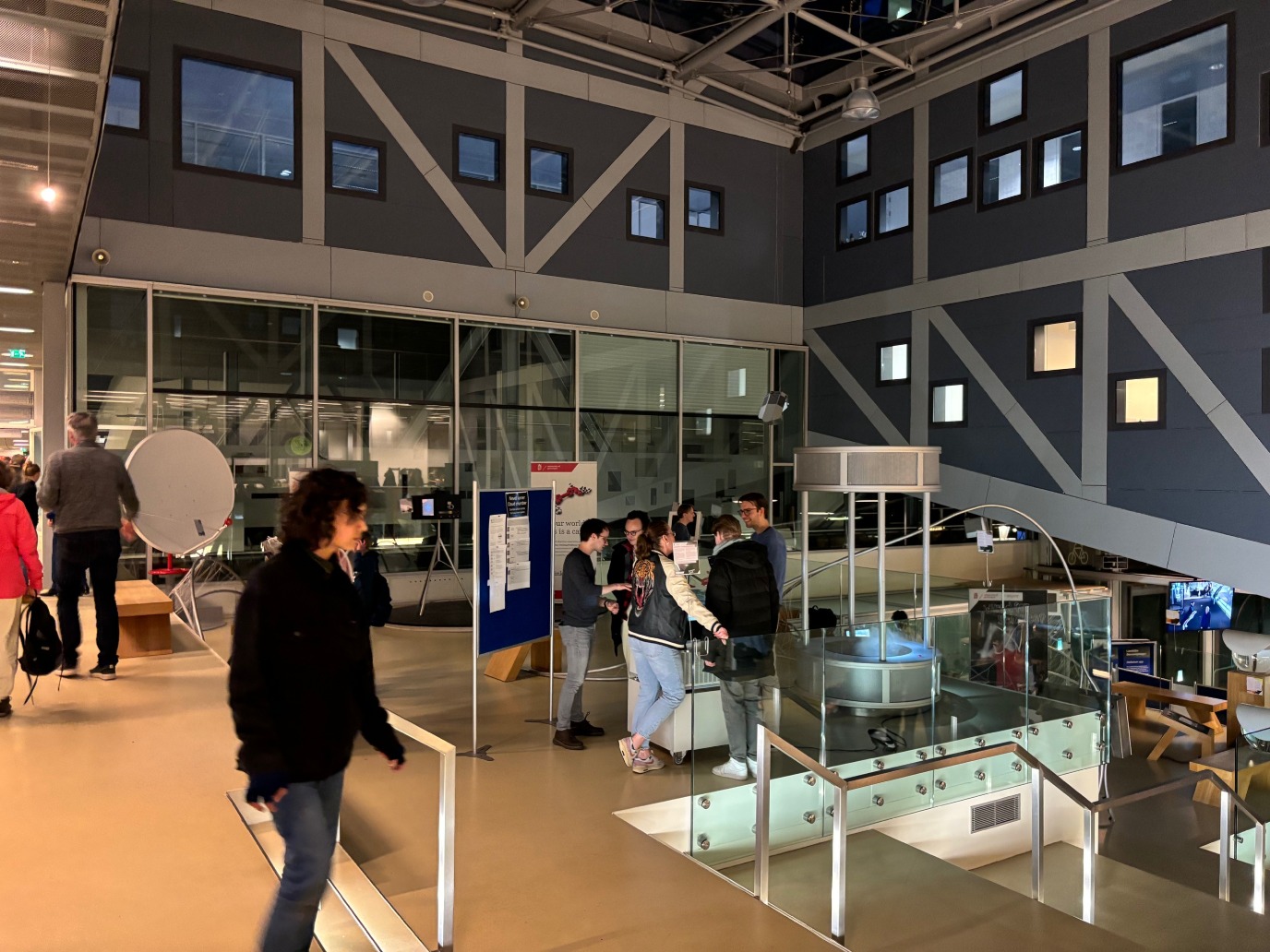
At the Science LinX exhibition you can discover fascinating observation techniques in a Black Box! ©Science LinX.

Astronomical research in Groningen takes place at the Kapteyn Institute (named after Jacobus Cornelius Kapteyn, the first professor of astronomy in Groningen). The Kapteyn Institute has been making an important contribution to national and international astronomical research since it was established. As well as research, for example on nearby star systems, interstellar matter and dark matter, the Kapteyn Institute also develops astronomical measuring instruments in collaboration with SRON. The institute is one of the driving forces behind LOFAR, the largest radio telescope in the world, situated near Groningen.

LOFAR is made up out of tens of thousands of sensors, which put together form a radio telescope with a surface twice the size of the Netherlands. ©ASTRON.

Thanks to the wide range of observation techniques, we are gaining an ever more complete picture of the ‘how & what’ of the universe. These observation techniques complement each other, occasionally to the great confusion of the observer. At the Science LinX exhibition you can see that different observation techniques in astronomy lead to the creation of very different images. This means it is often difficult to get a clear idea of the object under observation. Is a red nebula = a purple cloud = a blue spiral = a turquoise web?

Different views of a crab nebula displayed by alternating visible light and X-rays. ©Science LinX.

The development and deployment of new measuring instruments is of crucial importance, not only to astronomy, but for all empirical science. New measuring methods allow new data to be collected, and new data in their turn form the basis for new scientific theories. In other words, the way you observe determines what you see and thus what you learn...

What makes a good scientist? A combination of various observation techniques and then coming to the right conclusions! ©Adam Borkowski.

Links

Colophon

Special thanks to: Kapteyn Instituut, Prof. Peter Barthel, Prof. Thijs van der Hulst, Dr Gijs Verdoes Kleijn, Gergö Popping, Andrea Velicka, Corina van den Burgt, Nanja an Berkum, Renske de Jonge, Dr Michel Westenberg, Ingeborg Veldman, Frans van Hoesel and Laurens Voerman. Please contact Science LinX if you should have been included in the acknowledgements.

Author

Siëlle Gramser

Observation techniques are essential for coming to grips with the universe. ©Brechje Hollaardt.
Last modified:May 16, 2012 14:38
Associative links:
 
Current section:

Waarneemtechnieken