

|
Page content: Our planet is a huge ball surrounded by a wafer-thin layer of air. You could compare it with a balloon covered with a single layer of paper-mâché. A minute part of this layer is made up of CO2 molecules. But, after water vapour, this gas is the most important greenhouse gas, ensuring that the earth maintains an inhabitable temperature. But will it remain inhabitable, now that we’re producing so much CO2?
More and more scientific research is pointing to the increase in CO2 as a contributor to global warming. However, exactly how much warmer it is getting, and whether this increase in temperature is the same everywhere, remains unclear. There is even a small chance that the climate in Western Europe will become cooler. At present the warm Gulf Stream that originates in Mexico and passes the Western European coast has an important influence on our climate. But this warm stream could actually veer away from us thanks to global warming. Brrr!
How fast the atmosphere warms up is dependent on a number of other factors alongside CO2. This makes it difficult to foresee how the temperature will develop. But this does not prevent scientists from trying to predict how the temperature will change in the future. To this end they design complex climate models that simulate the actual situation as accurately as possible. In short, they try to determine which factors influence the air temperature, then try to calculate what effect a change in one of these factors will have on the climate, and finally attempt to capture all this in a mathematical model. The more accurate the model, the more reliable the prediction.
As the amount of CO2 in the atmosphere is such an important factor in the climate models, a worldwide network of CO2 monitoring stations has been created. The Centre for Isotope Research (CIO) of the University of Groningen is proud to run one of these monitoring stations, a 60m high mast near the Wadden Sea dike at Hornhuizen.
According to Harro Meijer of the Centre for Isotope Research, measuring CO2 is an art in itself. ‘The nearer you get to the earth, the more the CO2 concentration fluctuates.’ This is because the gas accumulates near the ground during the night, while during the day it is mixed with the higher-lying layers of air under the influence of sunlight. Moreover, the concentration of CO2 is higher in the winter than in the summer. These strong fluctuations make it difficult to determine the average CO2 concentration. ‘To reduce the influence of these fluctuations we measure at 60m high at a location on the coast,’ explains Meijer. ‘This reduces the influence of CO2 released from the soil and localized CO2 increases due to the burning of fossil fuels.’
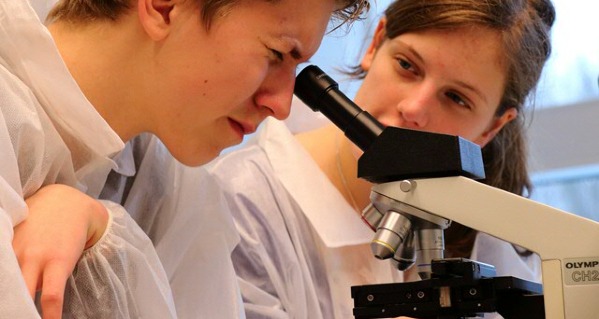
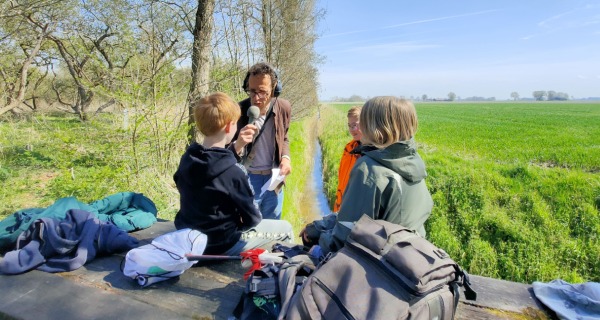
However, just one monitoring station is not good enough for Professor Meijer. So a few years ago he started SchoolCO2-Net, a network of schools with a CO2 meter and a weather station on the roof. The data are sent to an internet database. ‘We opted for a CO2 meter that is so accurate that the data is suitable for climate models as well as school projects. That will prove even more useful now we are expanding into the rest of Europe.’ So with SchoolCO2-Net, the Faculty is bringing science to schools!
Links
Acknowledgements Special thanks to: Menno Keij MSc., Prof. Martin Goedhart and the Institute for Didactics and Curriculum Development (IDO). Please contact Science LinX if you should have been included in the acknowledgements. Author Menno Keij Msc.
|
Associative links:
![]() Plastic power
![]() Is it OK...? Debate!
|
||||||||
|
|
|||||||||
Current section:
SchoolCO2-web |
|||||||||