
|
|
Page content: Introduction
The university was founded in 1614, but the city had a great tradition in education even before then. The Sint Maartenschool, a so-called Latin School, was famous throughout the country and even further: people came from as far away as France, Italy and Poland to study here with Groningers from the city and province. However, if someone from Groningen wanted a university education, then they had to go abroad. Cologne, Leuven and Paris were the best universities for Theology; Bologna, Bourges, Cologne and Orleans all had a good reputation for Law; prospective medical student could get the best education at the universities of Montpellier and Salerno.
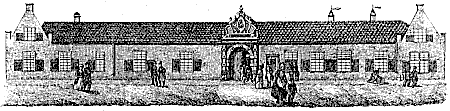
Provincial College , 1614-1811The council of the province Groningen and the Ommelanden, as the current province of Groningen was then known, founded the university on 23 August 1614. The brand new academy was housed in the old and unused Menolda and Sywen convent, on the North side of the Broerstraat. A year later saw the opening of the University Library and Anatomy Theatre in the Minderbroeder Cloister across the street from the Academiegebouw. The courtyard of the cloister was later used as an academic cemetery.
The university began with five professors for the faculties of Law, Medicine, Philosophy and Theology. The first Rector Magnificus was Ubbo Emmius (1547-1625), who was also a professor of Greek and History. There were 82 students enrolled in the first year of the university, including 30 foreigners. Only male students who had completed a primary education at a Latin school were admitted. Latin was the official school language until 1876.
The growth of the university began to stagnate around 1800. The political instabilities in the Netherlands around this time had consequences in university life. Foreign students stayed away due to the fact that the political and religious situation in their own country was much better and more stable than in the Netherlands. The number of enrolled students fell to 150, very little scientific research took place and many professor positions remained unoccupied for years.
The French occupation of the Netherlands led to both Groningen and Leiden Universities being administered by the French. In 1812 both universities were coupled to the Imperial University in Paris.
The nucleus of the university remained clustered around buildings on the Broerstraat and there was very little expansion out with this centre for most of the 19th century. There was, however, also a Botanical Garden in the Grote Rozenstraat, a small teaching hospital with eight beds in the ‘Groene Weeshuis’ and a Chemical Laboratory based in a summer house in the Prinsenhof.
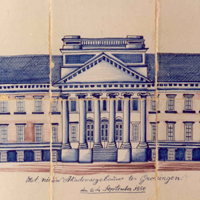
Rijkshogeschool, 1815-1876The founding of the ‘Kingdom of the Netherlands’ in 1815 saw the Imperial Universities of Groningen, Leiden and Utrecht being changed into Rijkshogescholen (State Colleges). The faculty of Philosophy was split up into faculties for Arts, Philosophy, Mathematics and Physics. The university could not be sure of its future at this time, despite increasing numbers of enrolled students: the number still remained under 200. The cloister, which functioned as the Academic Building, was torn down in 1846. The construction of a new, neo-classic, Academic Building was completed on the same site four years later. The upper floor of this building contained a Museum of Natural History with exhibits including stuffed birds, skeletons and various body parts in spirits.
Rijksuniversiteit 1877 - todayThe Higher Education Act of 1876 had an enormous impact upon the development of the university. The State College was renamed a State University (Rijksuniversiteit) and Latin was no longer the official language, as it was replaced by Dutch. The university was to continue its educational activities but also take on research responsibilities. This resulted in a fantastic expansion of the building of many labs and the founding of a number of university institutes. The faculties of Maths, Medicine and Physics all benefited from this Act. A new University Library was opened on the site of the present Universitymuseum in 1864. Labs were opened for Physiology (1866, beside the AcademicBuilding), Pharmacy (1880), Physics (1892, on the Westersingel), Botanics (1899, in the Grote Rozenstraat) and Mineral Geology (1901, on the Melkweg). A new teaching hospital was opened in 1903 on the Oostersingel.
The number of professors increased and there was the opportunity for further specialisation in a specific subject. The emphasis was placed upon the Exact Sciences. At the same time, the first professor for Modern Languages was appointed in 1881 and Groningen remained the only university in the Netherlands to offer education in Modern Languages until 1912. Women have been allowed to study at the university since 1871.
In 1906 a fire in the second Academic Building caused a great deal of damage. The priceless Natural History collection went up in smoke. Some good fortune led to the rescue of some archives, a student banner from 1665 and portraits of professors.
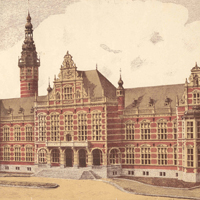
After the fire the third and current Academic Building was rapidly designed by state architect J.A. Vrijman. The building was opened in the jubilee year of 1909 in the presence of the Queen Mother Emma and His Royal Highness Prince Hendrik. The continued successes in the increasing numbers of enrolled students, research and a growing number of labs and institutes created a jubilant atmosphere in which to celebrate the 300th birthday of the university in 1914. 68 honorary doctorates were awarded; Queen Wilhelmina was one recipient. The growth of the university continued and the 1000th student enrolled in 1924.
The university gained international fame in 1953 when Prof. Frits Zernike received the Nobel Prize for Physics for his invention of the phase-contrast microscope. The improvement this microscope made was very important in the field of biological and medical research.
Expansion of the city after World War II meant that the university was being squeezed but city planning provided the room for new buildings for it. The Harmonie complex and a new library were built close to the Academic Building; the botanical garden made way for a new complex for Alpha sciences; the Academic Hospital was renovated and expanded; a new complex for Beta sciences was built in Paddepoel and a Biology Centre was created in Haren.
The Zernike site is named after Nobel Prize winner from Groningen, Frits Zernike. The faculties for Economics, Business, Spatial Sciences, Maths and Physics are all found here, as well as the former Biology Centre, now renamed faculty of Life Sciences. There are over 23,000 students enrolled in Groningen University and they can choose a course from 10 faculties that are housed in 150 buildings in the city and the surroundings. There are now approximately 450 professors and 5000 people working at the university. All these facts and figures mean that the University of Groningen is the third-biggest university in the Netherlands after Amsterdam and Utrecht.
|
Associative links:
|
|||||||||||||||||
|
|
||||||||||||||||||
Current section:
History |
||||||||||||||||||